Choosing the Right Production Partner
We’ve all been there. You walk into a ballroom during site inspection, and it feels… cavernous. Cold. A blank slate that is simultaneously full of potential and utterly terrifying. As a senior planner, you aren’t just looking at square footage or ceiling heights; you’re looking at a promise you made to your stakeholders. You promised them an experience that motivates the sales team, launches a product with a bang, or reassures investors. You promised them a moment that matters.
But there is often a massive, stressful gap between the vision in your head (or on your mood board) and the reality of what gets built on site. Bridging that gap is where the magic—and the anxiety—usually happens.
Too often, design is treated as decoration—a line item for centerpieces, pipe and drape, or a few uplights. But in the world of high-stakes corporate meetings, “pretty spaces” aren’t enough. You need event storytelling that pulls its weight. You need an environment that doesn’t just look good on Instagram but actually drives the business objectives of the gathering.
This is where the distinction between a “vendor” and a “production partner” becomes critical. A vendor rents you chairs. A production partner understands that the layout of those chairs impacts networking flow, attendee energy, and ultimately, the ROI of the session. Décor and production act as the bridge between cold logistics—rigging points, load-in schedules, union breaks—and the emotional journey of your attendees.
When you get this partnership right, the room doesn’t just look different; it feels different. And more importantly, it works.
From Mood Boards to Meaning
We know the drill. You start with a Pinterest board, a slide deck from the creative agency, or a few loose adjectives from leadership (“Make it feel innovative, but also grounded!”). The challenge is translating those abstract concepts into tangible event production elements that feel authentic to the brand.
It is easy to get caught up in the aesthetics of “cool.” We see a trend—say, neon flex lighting or biophilic walls—and want to toss it into the mix. But strategic design requires us to pause and ask: Why?
Aligning Creative Concepts with Brand Identity
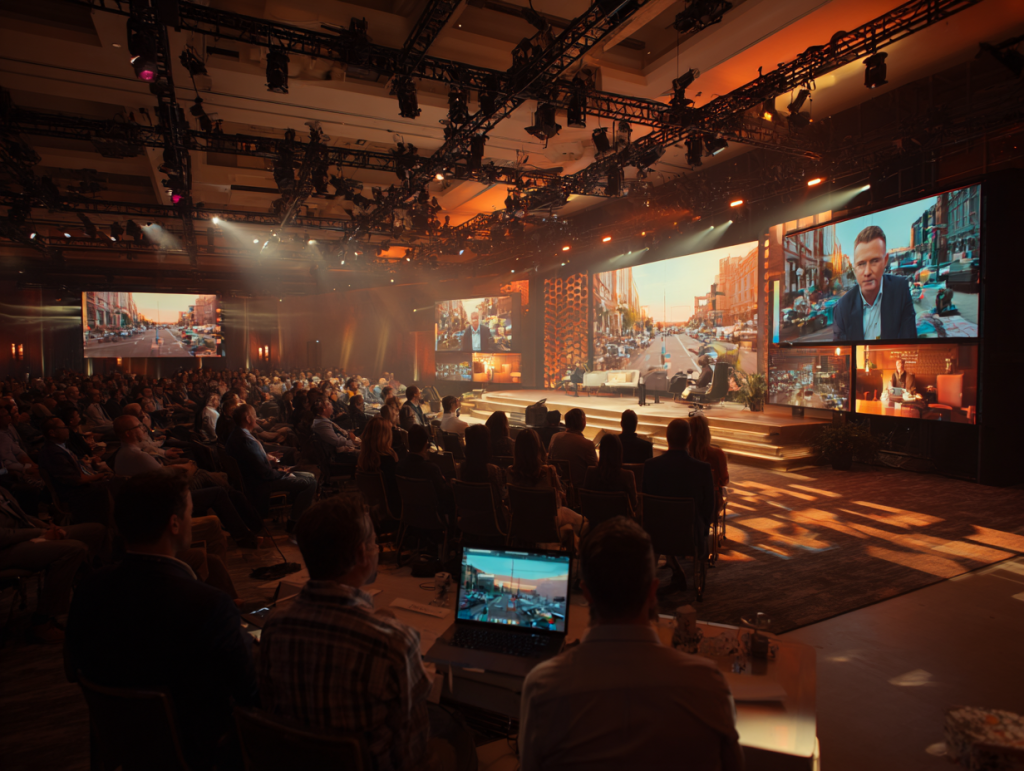
Your stage set is the largest billboard your brand will have for three days. If your company prides itself on transparency and openness, but your stage is cluttered with heavy, opaque structures and dark lighting, there is a subconscious disconnect for the audience.
This is where we apply Story Alchemē creative direction. It’s about moving beyond “Does this match our brand colors?” to “Does this match our brand soul?”
For example, if the theme of your sales kickoff is “momentum,” your design choices should reflect forward motion. This might look like dynamic lighting cues that travel across the room, scenic elements with angular, directional lines, or a stage layout that encourages movement rather than static presentations. Every texture, fabric, and pixel should serve the narrative.
Translating Color Theory into Brand Storytelling
Color is one of the most powerful, yet underutilized, tools in a planner’s arsenal. It’s not just about splashing the corporate Pantone 293C everywhere. It’s about emotional pacing.
We worked with a client recently who wanted “high energy” for the entire three-day conference. While the intention was good, high energy for 72 hours is exhausting. A strategic production partner helps you map the emotional journey using color theory.
- Morning General Sessions: Crisp whites, cool blues, and daylight-balanced lighting to wake up the brain and encourage focus.
- Afternoon Breakouts: Warmer ambers and soft greens to combat the post-lunch slump and encourage collaboration.
- Evening Awards: Deep purples, metallic golds, and high-contrast dramatic lighting to signal celebration and exclusivity.
By manipulating the environment, we guide the attendee’s emotional state, ensuring they are receptive to the content being delivered. That is design doing the heavy lifting.
Collaboration Across Teams
One of the biggest headaches for senior planners is managing the “Vendor Silo Wars.” You have the AV company fighting with the scenic shop because the screen is blocking the truss. You have the florist arguing with the caterer about table real estate. And you are stuck in the middle, playing referee while trying to keep your CEO happy.
True event production success happens when design partners are integrated with AV, content, and logistics from day one.
Integrating Design with AV and Content
Design and technology cannot live in separate houses. They need to be roommates. When we approach a project with a centralized planning mindset, we look at how the physical set interacts with the digital content.
Imagine a scenic backdrop that looks stunning in person but causes moiré patterns (that vibrating visual noise) on the IMAG screens during the livestream. Or a beautiful stage wash that washes out the presenter’s slides.
A strategic production partner acts as the glue. We ensure the scenic designer talks to the projectionist. We make sure the content team knows the aspect ratio of the LED wall before they start rendering graphics. This integration prevents those expensive, last-minute “oops” moments during load-in.
The Benefits of Centralized Production Management
When you consolidate your production oversight, you gain something invaluable: time. Instead of managing five different email chains about the same stage plot, you have one point of contact who sees the full picture.
This approach also allows for budget fluidity. If we save money on rigging because we came up with a ground-supported lighting solution, we can immediately reallocate those funds to enhance the attendee welcome experience. In a siloed model, that money usually just disappears or gets trapped in a specific vendor’s line item. Centralization gives you control and flexibility, two things every planner craves.
Balancing Creativity and Compliance
Here is the unsexy truth about event design: Gravity, fire codes, and labor unions don’t care about your vision board.
You might dream of a ceiling filled with thousands of floating paper lanterns to create a magical, ethereal atmosphere. It sounds incredible. But a seasoned production partner looks at that and immediately asks:
- Is the paper fire-retardant certified?
- Does the venue have the rigging points to support the truss grid required to hang them?
- Does the local union require a four-hour minimum call for the high-rigger crew?
- Will this interfere with the fire suppression sprinklers?
Working Within Regulations Without Limiting Impact
Compliance doesn’t have to be the enemy of creativity. In fact, constraints often breed the best innovation. The role of your production partner is to navigate these regulations so you don’t have to become an expert in local fire marshal codes.
We once had a client who wanted a massive, immersive tunnel entrance for their attendees. The venue’s fire egress rules made a hard structure impossible. Instead of killing the idea, we pivoted. We used projection mapping on sheer, fire-rated voile fabric. It created the same immersive tunnel effect, was fully compliant with egress laws (since fabric can be pushed through easily), and actually cost less than the hard set build.
This is the value of partnership. A vendor says “No, that’s against code.” A partner says, “We can’t do it exactly like that, but here is how we achieve the same feeling safely.”
Managing Union Labor and Budgets
For large-scale events in major cities, union labor is a significant line item and a complex logistical puzzle. A design that looks simple might require three different trade unions to assemble—carpenters for the set, electricians for the lights, teamsters for the load-in.
Strategic design accounts for this. We might recommend modular scenic pieces that snap together quickly to reduce labor hours. We might suggest pre-rigging trusses at ground level to minimize time at height. These operational decisions are design decisions. They ensure your budget goes toward things attendees actually see, rather than overtime hours during setup.
The ROI of Design
“Make it pop” is not a business metric. “Make it profitable” is.
As planners, you are under increasing pressure to justify every dollar spent. Why should we spend $50,000 on a custom stage set when a pipe and drape background costs $5,000? It is a fair question. The answer lies in the ROI of engagement.
Driving Engagement and Retention
We know from cognitive science that environment dictates behavior. If you put people in a sterile, cold room with bad lighting, they become passive observers. They check their phones. They tune out.
If you put them in a thoughtfully designed environment that stimulates their senses, they become active participants.
- Memory Retention: People remember how they felt more than what they heard. A visually striking environment creates “memory anchors” that help attendees recall the content attached to that moment.
- Perceived Value: The production quality serves as a proxy for the company’s health and ambition. A glitchy, cheap-looking production signals a company that is cutting corners. A polished, cohesive production signals a company that is confident and leading the market.
- Social Amplification: In the digital age, every attendee is a broadcaster. A “grammable” design extends the reach of your event far beyond the four walls of the ballroom. That organic social sharing is free marketing that drives brand awareness.
When we present design concepts, we don’t just talk about aesthetics. We talk about outcomes. “This seating layout will increase networking collisions by 30%.” “This screen configuration will improve visibility for the back row, ensuring message retention for the entire audience.” Design is a tool for business success.
Trends That Matter
The world of event production moves fast. What looked cutting-edge three years ago looks dated today. However, as strategic partners, we filter out the fads and focus on the trends that actually solve problems for planners.
Here are three shifts in design that are reshaping our industry:
1. Modular Scenic Design
Gone are the days of “build and burn”—custom sets that are used once and then thrown in a dumpster. That is bad for the budget and terrible for the planet. We are moving toward high-quality, modular scenic systems. These are reusable frames and structures that can be skinned with custom graphics, fabrics, or digital surfaces. They offer the bespoke look of a custom build but at a fraction of the fabrication and shipping cost. Plus, they allow for infinite reconfiguration year over year.
2. Sustainable Materials
Sustainability is no longer a “nice to have”; it is a corporate mandate. We are seeing a massive shift toward eco-conscious design materials. This includes:
- Cardboard-based furniture that is surprisingly sturdy and fully recyclable.
- Printed fabrics made from recycled ocean plastics.
- Digital signage replacing thousands of printed foam-core meter boards.
- Locally sourced decor to reduce carbon footprint from shipping.
Your design choices can—and should—support your company’s ESG (Environmental, Social, and Governance) goals.
3. Digital Set Extensions
Hybrid events taught us the power of digital layers. Even for in-person events, we are using “digital set extensions.” This might mean using LED walls not just for slides, but as digital scenery that changes the “location” of the stage instantly. One minute you are in a high-tech lab, the next you are in a cozy fireside chat living room. This flexibility allows us to tell more diverse stories without physically rebuilding the stage every hour.
Design isn’t what fills a space—it’s what connects it.
At the end of the day, your event isn’t about the truss, the lumber, or the lumens. It is about the connection between your message and your audience.
Great design clears the noise. It removes the friction of a confusing layout. It eliminates the distraction of poor lighting. It creates a physical and emotional clearing where your message can land with impact.
As a senior planner, you shouldn’t have to carry the weight of “making it look good” on your own. You need a partner who treats your vision with the same strategic rigor you apply to your agenda. You need Story Alchemē creative direction that turns the invisible threads of your brand into a tangible reality.
So, the next time you stand in that empty ballroom, don’t stress about filling the space. Focus on how you want to connect the people inside it. We’ll handle the rest.